Condensate lines, clogged drain pans, and poorly insulated ductwork produce a slow, hidden category of water damage in Flushing, one that typically surfaces as ceiling staining or mold growth well after the leak began.
We cover Flushing ZIP codes 11355, 11354, 11367 and 11358, plus the surrounding Queens area.
Flushing is the second-largest of the 39 communities we cover in Queens, with roughly 219,342 residents across 4 ZIP codes, about 9.9% of our covered Queens population. On FEMA's National Risk Index the area carries the highest coastal flood-risk tier FEMA tracks alongside FEMA's top inland flood-risk tier. Crews working Flushing also cover Corona, Elmhurst, Ridgewood, so equipment is rarely far from the job.
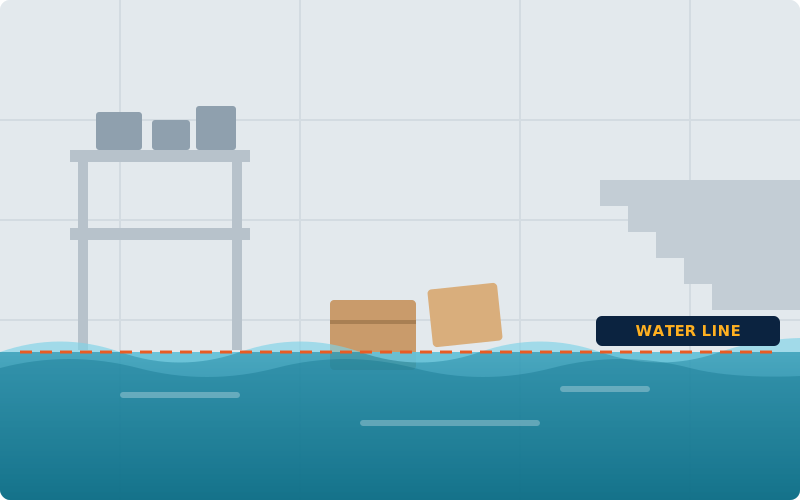
Category 3 water needs biohazard handling, not a wet vac. We contain the area, remove unsalvageable porous material, and disinfect to standard.
Standing water and saturated insulation in a crawl space keeps feeding humidity into the floor above long after the visible water is gone.
Kitchen and bath cabinetry traps water against subfloor and wall. Toe kicks often have to come out to dry what's underneath.
Hardwood and engineered flooring can look fine while the subfloor underneath stays wet. We check both layers before calling a job dry.
Dispatch covers these Flushing ZIP codes directly.
First priority on any Flushing emergency call: get the standing water out, fast, with equipment rated well above portable units.
Learn more →Air movers and dehumidifiers bring Flushing structures back to documented pre-loss moisture levels, tracked with meters rather than guesswork.
Learn more →Emergency tarping and storm damage repair for Flushing properties, with documentation built for the claim from day one.
Learn more →Sewage backups and floodwater in Flushing are Category 3 losses requiring biohazard-rated cleanup, disposal, and disinfection.
Learn more →You call, we ask a few questions about the damage, and dispatch the nearest available crew — day or night.
Techs arrive with moisture meters and thermal cameras to map how far water has traveled behind walls and under floors.
Truck-mounted extraction removes standing water, then industrial air movers and dehumidifiers dry the structure to pre-loss moisture levels.
We repair or rebuild affected areas and hand you full documentation your insurance adjuster can use to process the claim.
“Our basement took on four feet of water during a storm and their crew had extraction pumps running within the hour. Dried out in three days, no mold.”
— Homeowner, Elmhurst, Queens“Pipe burst on the third floor of our building over a holiday weekend. They picked up on the first ring and had techs on site before the plumber even arrived.”
— Property Manager, Brooklyn“They dealt with our insurance adjuster directly and the paperwork actually made sense for once. Would call again, hopefully won't need to.”
— Homeowner, YonkersYes, dispatch is staffed around the clock every day of the year. Water damage doesn't keep business hours, so neither does our phone line.
Most residential losses dry in three to five days once equipment is running, though heavily saturated framing or hardwood can take longer. We track readings daily rather than working to a fixed schedule.
Yes. We handle single-family homes, multi-unit buildings, and commercial space in Flushing, and we scope adjoining units when water has crossed shared walls.
If it's safe, shut off the water source and move valuables clear of the water. Avoid standing water near outlets or panels, and don't try to extract large volumes with household equipment, which usually drives moisture deeper into the structure.
Yes. We cover Flushing ZIP codes 11355, 11354, 11367 and 11358, plus the surrounding Queens area. If your ZIP code isn't listed, call (844) 630-6125 and dispatch will confirm coverage right away.
Call dispatch and we'll walk you through what to do until the crew arrives.
Call (844) 630-6125