Washing machine hoses, dishwasher supply lines, refrigerator ice makers, and water heater tanks account for a striking share of the sudden-loss claims we handle in Corona, and they almost always fail while nobody is home to shut the valve.
We cover Corona ZIP code 11368 and the surrounding Queens area.
Corona is the 4th-largest of the 39 communities we cover in Queens, with roughly 109,931 residents across 1 ZIP code, about 5.0% of our covered Queens population. On FEMA's National Risk Index the area carries the highest coastal flood-risk tier FEMA tracks alongside FEMA's top inland flood-risk tier. Crews working Corona also cover Elmhurst, Ridgewood, Woodside, so equipment is rarely far from the job.
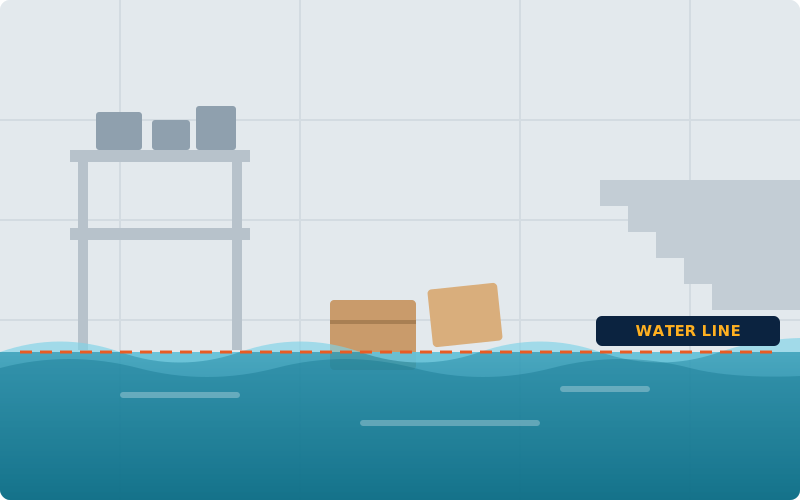
Saturated batt insulation loses R-value and holds moisture indefinitely. Once wet it's removed rather than dried in place.
Musty odor after a loss usually means moisture is still present somewhere. We locate the source rather than masking the smell.
Standing water and saturated insulation in a crawl space keeps feeding humidity into the floor above long after the visible water is gone.
Water entering above the ceiling line spreads laterally through insulation, so the visible stain is rarely directly beneath the actual entry point.
Dispatch covers these Corona ZIP codes directly.
First priority on any Corona emergency call: get the standing water out, fast, with equipment rated well above portable units.
Learn more →Air movers and dehumidifiers bring Corona structures back to documented pre-loss moisture levels, tracked with meters rather than guesswork.
Learn more →Emergency tarping and storm damage repair for Corona properties, with documentation built for the claim from day one.
Learn more →Sewage backups and floodwater in Corona are Category 3 losses requiring biohazard-rated cleanup, disposal, and disinfection.
Learn more →You call, we ask a few questions about the damage, and dispatch the nearest available crew — day or night.
Techs arrive with moisture meters and thermal cameras to map how far water has traveled behind walls and under floors.
Truck-mounted extraction removes standing water, then industrial air movers and dehumidifiers dry the structure to pre-loss moisture levels.
We repair or rebuild affected areas and hand you full documentation your insurance adjuster can use to process the claim.
“Our basement took on four feet of water during a storm and their crew had extraction pumps running within the hour. Dried out in three days, no mold.”
— Homeowner, Elmhurst, Queens“Pipe burst on the third floor of our building over a holiday weekend. They picked up on the first ring and had techs on site before the plumber even arrived.”
— Property Manager, Brooklyn“They dealt with our insurance adjuster directly and the paperwork actually made sense for once. Would call again, hopefully won't need to.”
— Homeowner, YonkersCost depends on how much of the structure got wet, the category of water involved, and how long it sat. We give a written estimate after inspection; on covered losses your out-of-pocket is usually your deductible.
Most residential losses dry in three to five days once equipment is running, though heavily saturated framing or hardwood can take longer. We track readings daily rather than working to a fixed schedule.
Usually, if drying starts quickly. Mold needs sustained moisture, so the difference between a drying job and a remediation job is often just how many hours the water sat.
We document the loss with dated photos, daily moisture readings, and an itemized scope of work, and can communicate directly with most major carriers' adjusters.
Yes. We cover Corona ZIP code 11368 and the surrounding Queens area. If your ZIP code isn't listed, call (844) 630-6125 and dispatch will confirm coverage right away.
Call dispatch and we'll walk you through what to do until the crew arrives.
Call (844) 630-6125